AI-Generated Information Management System Process
Process task execution is one of XDevelop's core capabilities. Through the "AI-Generated Information Management System" process, requirement descriptions are automatically transformed into a complete, runnable information management system.
The entire process is collaboratively completed by 6 sub-agents, from functional design to frontend and backend code delivery, achieving true AI-driven full-stack development.
Process Overview
The process consists of the following 6 sub-agents executing sequentially:
- The first three sub-agents handle the design phase — transforming requirements into structured system design documents
- The last three sub-agents handle the development phase — generating specific, runnable business code based on the design documents
Sub-Agent Working Mechanism
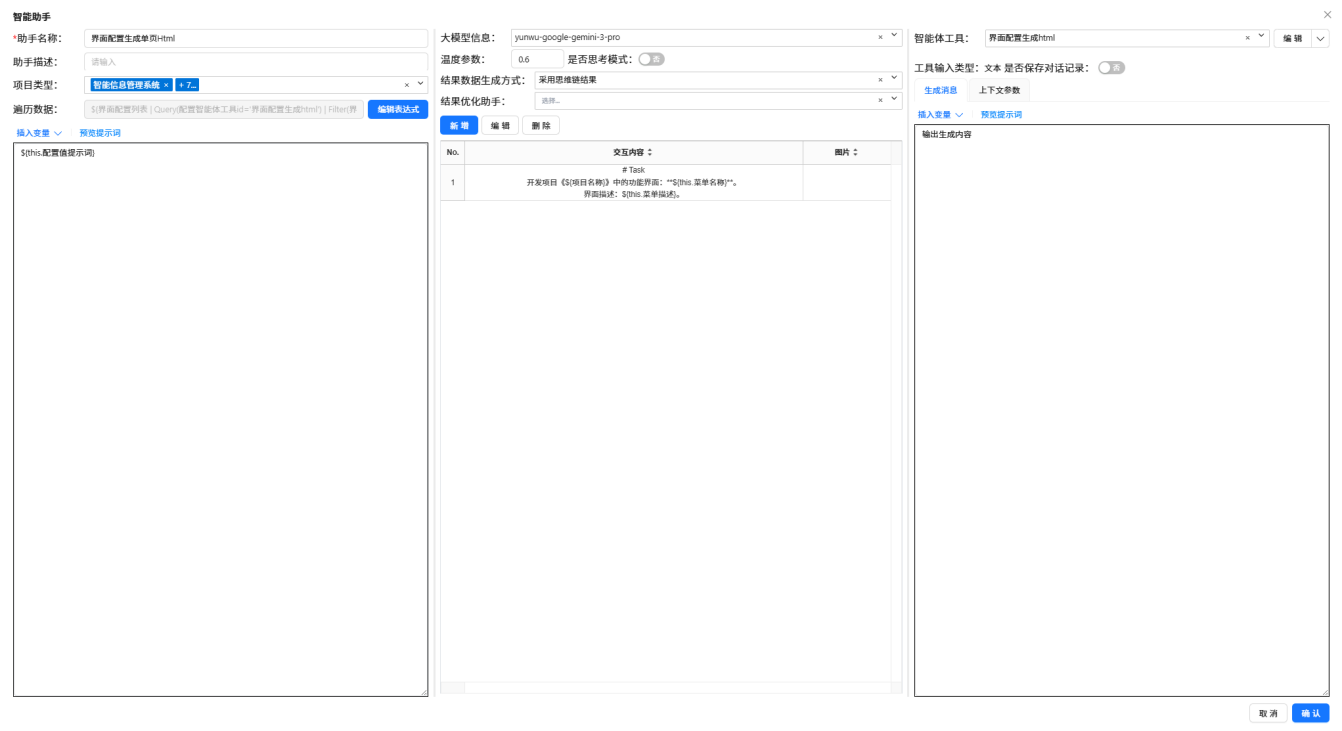
Each sub-agent is bound to a corresponding agent tool (e.g., "Save Functional Description"). The system drives the sub-agents through two sets of prompts:
- System Prompt — Defines the sub-agent's role, responsibilities, and output specifications, telling the AI who you are and what to do
- Generation Message Prompt — Carries specific input data (usually from the previous sub-agent's output), telling the AI to generate content based on this information
Sub-agents reference each other's output data through expressions, for example:
Detailed Breakdown of the Six Sub-Agents
1. Functional Description
The functional description is the starting point of the process, responsible for generating the full functional blueprint of the project.
- Analyzes requirement descriptions provided by the user, outlining which functional modules the project includes
- Defines the core capabilities of each module
- Clarifies the relationships between modules
- Provides directional guidance for subsequent stages
2. Data Model & Fields
The data model and fields are the skeleton of the system.
- Designs the complete database table structure
- Defines field types, primary key and foreign key relationships
- Ensures the data layer can support the implementation of all business functions
- Outputs executable database table creation statements
3. Function Menu
The function menu defines the system's interface navigation structure.
- Generates the system's menu tree and page list
- Clarifies the entry position and hierarchical relationship of each page
- Provides an interface blueprint for frontend code generation
4. Code Definition
The code definition is the central hub of the entire process.
From a system-wide perspective, it establishes coding standards and constraints for each functional module:
- API naming conventions
- Data validation logic
- Permission control strategies
- Exception handling standards
This sub-agent does not write specific code but rather establishes rules, ensuring that the subsequently generated backend and frontend code follows unified standards.
5. Backend Code
The backend code is the concrete implementation of the system's business logic.
Under the constraints and standards set by the code definition, it generates based on the data model:
- API routes (RESTful API)
- Database operations (CRUD)
- Business logic processing
- Exception handling mechanisms
- Permission verification middleware
Transforming design blueprints into real, runnable server-side code.
6. Frontend Code
The frontend code is the interface that users ultimately see.
Combines the following inputs to generate complete frontend page code:
- Function Menu Tree — Interface structure
- Code Definition — API specifications
- Functional Description — Business logic
Generated content includes page layout, component interaction, data binding, style rendering, etc.
Process Characteristics
Expression References, Flexible Orchestration
Sub-agents reference the output data of other nodes through expressions (e.g., ${Project Info.Functional Description}), rather than through a fixed chain of delivery. Each sub-agent can reference the output of any one or more preceding nodes as needed.
Multi-Format Output
Based on the business scenario, sub-agents can output data in different formats:
- JSON — Structured data
- Markdown — Document content
- HTML — Page fragments
Not limited to a single format, flexibly adapting to different scenarios.
Single Responsibility, Replaceable
Each sub-agent does only one thing and does it well, making it easy to optimize or replace individual stages later.
Constraints Upfront
The code definition stage establishes standards in advance, ensuring that backend and frontend code are consistent in style and controllable in quality.
For complex systems, it's recommended to let AI complete a full basic process run first, then use the XD Dev Assistant commander for detailed adjustments. Building the skeleton first and then refining it is far more efficient than trying to get everything right in one go.
Figure: Sub-Agent · Frontend Code